
Lupin flour is milled from sweet lupin beans and runs roughly 37-41% protein with around 27-30g of fibre per 100g, several times the protein of wheat flour, and very little available carbohydrate. Here is what it is, what it tastes like, how to bake with it, where to actually buy it in Australia, and how it differs from the more refined lupin protein isolate.
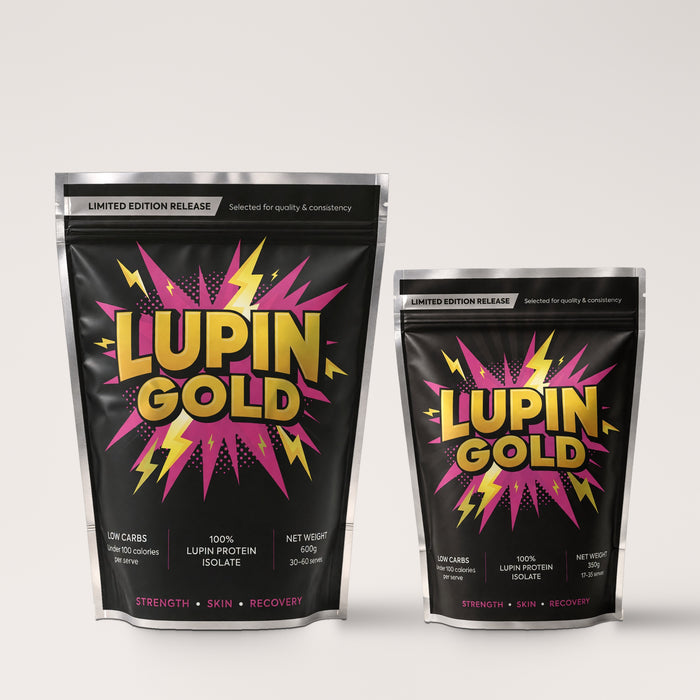
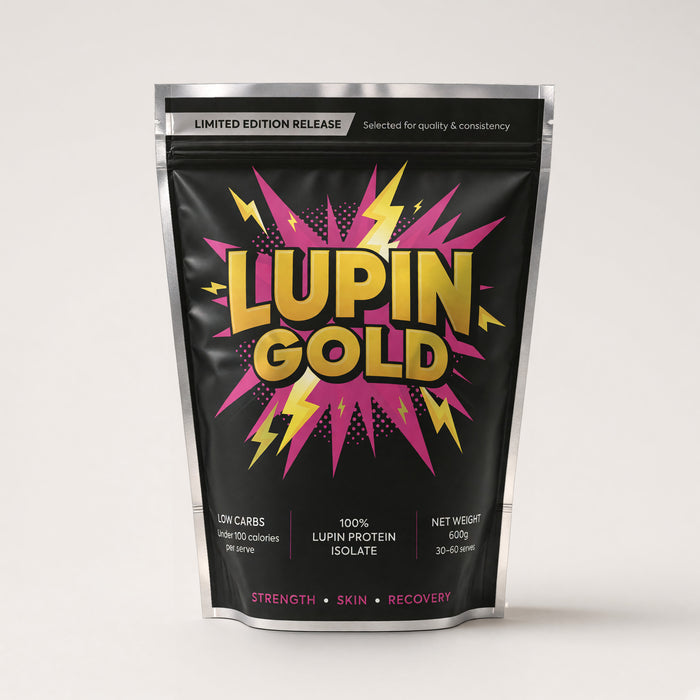
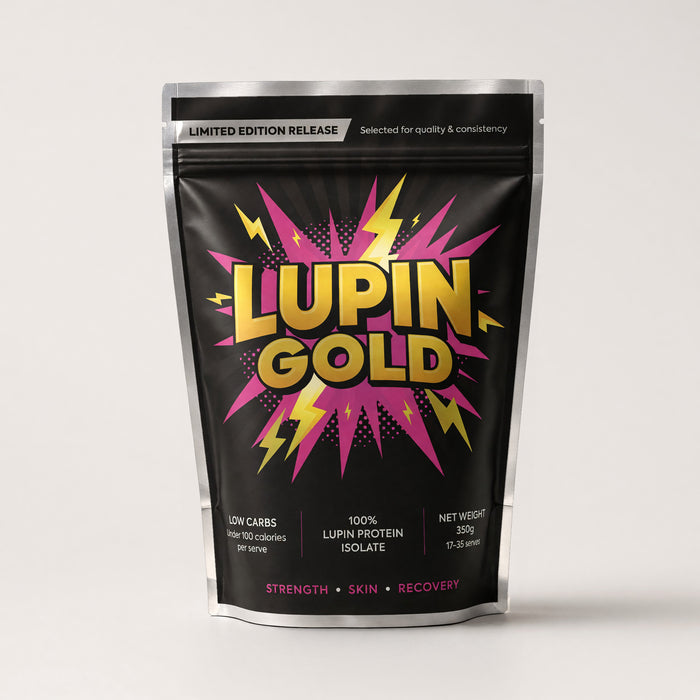
Quick note before you read on: Lupin Gold is not lupin flour. It is a lupin protein isolate, made from the same sweet lupin bean and refined to around 90% protein. So while it is not a flour, you can use it in place of some of the flour in your cooking and baking, the same way you would use lupin flour, just with more than twice the protein. Here is how the swap works.
What Is Lupin Flour Made From?
Lupin flour is made by milling dried sweet lupin beans into a fine powder. It has been used in Australian and European baking as a high-protein, lower-carb alternative to wheat flour. Sweet lupins, particularly Lupinus angustifolius, the variety grown extensively in Western Australia, are naturally low in starch, high in fibre and a useful source of plant protein.
It retains the full range of the bean's components, including fibre, some natural compounds, and variable texture depending on processing method and batch. That is the main difference between flour and the more refined isolate covered further down.
Lupini flour, lupine flour and lupin bean flour are the same thing: milled lupin beans. Lupini is the Italian name for the bean, lupine is the American spelling, and lupin is what you will see on Australian packs and in the allergen statement.

Lupin Flour Nutrition
One wrinkle worth knowing up front: the Australian Food Composition Database has no entry for lupin flour specifically. It holds figures for dehulled lupin splits and flakes, which are the same kernel that flour is milled from, so those are the closest official numbers available. Producers publish their own panels, and the two do not fully agree.
| Per 100g | Lupin, dehulled splits (FSANZ AFCD) | Lupin flour (The Lupin Co, WA producer) |
|---|---|---|
| Protein | 37.5 g | 38-41% |
| Dietary fibre | 27.8 g | 36-39% |
| Fat | 7.9 g | 6-7% |
| Carbohydrate | 10 g (available) | 2.5-4% (digestible) |
| Energy | 1,320 kJ (incl. fibre) | 1,350 kJ |
The fibre and carbohydrate figures diverge between the two columns, and that gap is a measurement-method difference rather than a difference in the bean. We have shown both rather than averaging them into a number neither source actually supports. Either way the shape is the same: high protein, very high fibre, very little available carbohydrate.
Sources: FSANZ Australian Food Composition Database Release 3.0, food ID F005249 (lupin, dehulled, splits, uncooked); The Lupin Co lupin flour technical data sheet. Figures checked 02/09/2026.
Is lupin flour the lowest carb flour?
It is close to the bottom of the list. On the figures above, lupin flour carries somewhere between 2.5g and 10g of available carbohydrate per 100g, depending on whose measurement you use. Plain wheat flour sits at around 70g.
The other common low-carb picks, almond meal and coconut flour, are also low in available carbs, but neither comes near lupin flour on protein. If you want a flour that is low carb and high protein at the same time, lupin is hard to beat.
As for the healthiest flour in Australia, there is no single winner: it depends on what you are after. For protein and fibre per gram, lupin flour is right up there. For a light sponge, you still need wheat.

Is Lupin Flour Gluten-Free?
The bean itself contains no gluten. The Australia New Zealand Food Standards Code defines gluten as the main protein in wheat, rye, oats, barley, triticale and spelt. Lupin is a grain legume and appears nowhere on that list. Coeliac Australia endorses at least one Australian lupin flour product, which is about as direct a confirmation as a consumer can get.
That is the ingredient, not the bag. A naturally gluten-free ingredient can still pick up gluten in a facility that also handles wheat, so whether a particular lupin flour is gluten-free in practice comes down to the mill and its allergen management. Read the pack's gluten-free claim and its cross-contact statement rather than assuming from the ingredient alone.
Separately, and importantly: lupin is a declared allergen in Australia. Since the Food Standards Code was varied in 2017, any food containing lupin or a lupin derivative must declare it using the word "lupin", bolded in the ingredient list and repeated in a bold "Contains lupin" summary statement. FSANZ describes lupin as an emerging food allergen of public health significance, with some cross-reactivity in people allergic to peanut.
Where lupin turns up: lupin flour and lupin protein are used in some breads, pastries, pasta, and gluten-free and high-protein products. If you are avoiding it, the bold "Contains lupin" statement on the pack is the thing to check, and if you have a peanut allergy, talk to your GP or allergist before trying lupin.
What Does Lupin Flour Taste Like?
Standard lupin flour has a mild, slightly nutty, faintly earthy flavour. Some batches carry a noticeable bitterness. That varies with the variety and with how thoroughly the bean was debittered and processed, which is why two bags from different mills can taste quite different.
Texture is the other variable. Whole-milled lupin flour can feel slightly gritty or drying in a finished bake, particularly at higher substitution rates. If your first attempt tasted chalky, the substitution level is usually the culprit rather than the flour itself.
How to Bake With Lupin Flour
Lupin flour contains no gluten, so it cannot carry a bake on its own: there is nothing in it to build structure with. Treat it as a partial swap rather than a one-for-one replacement.
- Substitute 5-20% of the wheat flour. That is the range the Grains & Legumes Nutrition Council gives for bread dough and baking, and Australian producers agree: The Lupin Co suggests swapping out up to 20%
- Expect it to drink more liquid: bakes that come out dry usually need a little extra liquid rather than less lupin
- Best in robust bakes: muffins, pancakes, banana bread, protein balls, slices and flatbreads, where a denser crumb is welcome
- Hardest in delicate bakes: light sponges and laminated pastry, where gluten structure is doing most of the work
- Expect a colour shift: lupin is naturally golden, so bakes come out yellower than the wheat-flour version. That is pigment, not over-baking
Lupin Beans, Lupin Flakes and Lupin Flour
Lupin is sold in several forms and they are not interchangeable. All of them come from the same bean; what separates them is how much of the rest of the bean is left in.
- Lupin beans: usually sold cooked and brined in jars as lupini, eaten as a snack or added to salads. Whole, not milled
- Lupin flakes: the split kernel heated and rolled flat, much like a rolled oat, at about 37g protein and 27g fibre per 100g. Used in porridge, granola, and as a coating or crumb. Coarser than flour and not a substitute for it in baking
- Lupin flour: the kernel milled to a powder, around 37-41% protein
- Lupin protein isolate: refined further again, concentrating protein to around 90%. This is what Lupin Gold is
Where to Buy Lupin Flour in Australia: Coles, Woolworths or Online
Lupin flour is not a supermarket staple at Coles or Woolworths, and it is worth being specific about that. Checked on 02/09/2026, Coles listed no lupin products at all, and the lupin flour that appears on the Woolworths site is sold through their third-party Everyday Market platform rather than the supermarket range. Range can vary by store, but a national online catalogue returning nothing is a fair indication.
So in practice it is a specialty-store trip or an online order. And when you do track some down, the protein percentage varies meaningfully between mills, which matters, because for most people the reason they went looking for lupin flour in the first place is protein.
The easier swap: use Lupin Gold for some of your usual flour
You do not need to hunt down a specialty flour to get more protein into your baking. Swap a portion of the flour in your normal recipe for Lupin Gold lupin protein isolate. It is the same bean, refined further, around 90% protein against 37-41% for the flour, so you get more protein from less powder, with a smoother, neutral taste and none of the grit.
Start by replacing about 20-30% of the flour, or simply add a scoop to the recipe as a protein booster. It works in muffins, pancakes, banana bread, protein balls, slices and flatbreads, and it stirs cleanly through smoothies, oats and yoghurt with no adjustment at all.
Shop Lupin Gold for your baking
What Is Lupin Protein Isolate?
Lupin protein isolate takes the process further. Through specialised refinement, most of the carbohydrate, fat and fibre is removed, concentrating the protein content to around 90% by weight. The result is a smoother, more neutral product that behaves differently in the kitchen.
Lupin Gold is a 100% lupin protein isolate: single ingredient, ~90% protein, no additives. It is made from European-grown lupins, refined in Germany and packed in WA.
Lupin Flour vs Lupin Protein Isolate: Key Differences
| Feature | Standard lupin flour | Lupin Gold protein isolate |
|---|---|---|
| Protein content | ~37-41% by weight | ~90% by weight |
| Fibre | High: around 27-30g per 100g | Low: most fibre removed in refining |
| Digestibility | Varies: can feel heavy for some | PDCAAS of 0.96 |
| Texture | Can be gritty or bitter depending on batch | Smooth, neutral, clean |
| Additives | Depends on brand | Single ingredient: nothing added |
| Best use | Partial flour substitution in baking | High-protein baking, smoothies, oats, cooking |
| Amino acid profile | Complete but at lower protein concentration | Complete: all nine EAAs including arginine and glutamine |
Why Lupin Gold Outperforms Standard Lupin Flour
- Higher protein concentration: ~90% vs ~37-41% in standard flour, meaning more protein per gram of powder
- Cleaner taste: the refining process removes the grit and bitterness that can affect some lupin flour products
- No additives: single ingredient, no emulsifiers, sweeteners, gums or fillers
- Tested protein quality: a PDCAAS of 0.96, a protein quality score that factors in digestibility
- Complete amino acid profile: all nine essential amino acids including naturally high arginine and glutamine
- Neutral taste: disappears into smoothies, oats, batters and savoury cooking without affecting flavour
One honest trade-off: refining strips out most of the fibre, so the isolate is a protein ingredient rather than a fibre one. If you want both in the same meal, use it alongside high-fibre ingredients like oats, chia and wholemeal, which is how most of our protein recipes are built.
Amino acid highlights: naturally high in arginine (a precursor to nitric oxide, which is involved in normal blood vessel function and circulation) and glutamine, which is involved in gut lining cell function and immune cell activity.
How to Use Lupin Gold in the Kitchen
Lupin Gold behaves more like an ingredient than a supplement. Because it's unflavoured and neutral, it works across both sweet and savoury applications.
- Baking: substitute a portion of flour in muffins, pancakes, protein balls, slices and bread for a protein boost without changing flavour
- Smoothies: blend a serve into a smoothie for a high-protein, neutral-tasting base
- Oats and overnight oats: stir through oats or overnight oats, where it mixes in and adds ~27g protein per 30g scoop
- Savoury cooking: use as a grain-free crumb for schnitzels, patties or veggie bakes, or stir into soups and sauces
- Yoghurt bowls: mix into yoghurt for a simple high-protein breakfast
Real Kitchen Results
PT Darryn from Hillarys Health Club used Lupin Gold to make a simple high-protein breakfast bake. No specialist recipe, just quality ingredients and a higher-protein flour swap.


Banana Bread Test


Why Lupin Is a Sustainable Crop
- Nitrogen-fixing: lupins naturally fix atmospheric nitrogen, supporting soil health and reducing fertiliser inputs
- Low water requirements: suited to the drier conditions of southern Australia
- Crop rotation benefit: lupin crops improve soil structure and productivity for subsequent crops
Ready to try it in your kitchen?
Shop Lupin Gold protein isolateRelated: protein recipes using Lupin Gold - lupin vs other protein sources - allergen information
FAQs
What is the difference between lupin flour and lupin protein isolate?
Lupin flour is milled directly from dried lupin beans and contains roughly 37-41% protein along with a high level of fibre, plus some carbohydrate and fat. Lupin protein isolate is more refined: most of the non-protein components are removed, concentrating protein to around 90% by weight. The isolate has a smoother texture, cleaner taste and higher digestibility, but far less fibre.
Can you buy lupin flour at Coles or Woolworths?
When we checked on 02/09/2026, Coles listed no lupin products, and the lupin flour on the Woolworths site was sold through its third-party Everyday Market platform, not the supermarket range. Range can vary by store, so in practice it is a specialty store or an online order.
What is the difference between lupin flour and lupin flakes?
Lupin flakes are the split lupin kernel heated and rolled flat, much like a rolled oat, and are used in porridge, granola and as a coating. Lupin flour is the kernel milled to a fine powder. Nutritionally they are close (flakes are about 36.9g protein and 27g fibre per 100g), but they are not interchangeable in the kitchen, because flakes are far coarser and will not behave like flour in a batter or dough.
How much lupin flour can I substitute for wheat flour?
The Grains & Legumes Nutrition Council recommends substituting 5-20% of the wheat flour in a bread dough or baking recipe with lupin flour, and Australian producers give similar guidance. Lupin flour contains no gluten, so it cannot provide structure on its own and a one-for-one swap will usually turn out dense and dry. Expect to add a little extra liquid, since lupin flour absorbs more than wheat.
Is lupin flour gluten-free?
The bean is. The Australia New Zealand Food Standards Code defines gluten as the main protein in wheat, rye, oats, barley, triticale and spelt, and lupin is a legume that appears nowhere on that list. Whether a particular lupin flour is gluten-free in the bag depends on the mill, because a naturally gluten-free ingredient can still pick up gluten in a facility that also handles wheat. Read the pack's gluten-free claim and its cross-contact statement rather than assuming.
Is lupin an allergen?
Yes. Lupin is a declared allergen in Australia. Since the Food Standards Code was varied in 2017, any food containing lupin or a lupin derivative must declare it using the word "lupin", bolded in the ingredient list and repeated in a bold "Contains lupin" statement. FSANZ describes lupin as an emerging food allergen of public health significance, and some people with peanut allergy show cross-reactivity to lupin.
Can I use lupin protein isolate instead of lupin flour?
Yes, but the higher protein concentration means it behaves differently in baking. Rather than a straight 1:1 flour swap, use it as a partial substitution or as a protein booster added to existing recipes. It works well in smoothies, oats and yoghurt without any adjustment needed. Note that it will not give you the fibre that the flour does.
Is lupin flour keto-friendly?
Both lupin flour and lupin protein isolate are far lower in available carbohydrate than wheat flour, making them suitable for many low-carb approaches. Lupin flour is particularly notable here: official figures put available carbohydrate at around 10g per 100g, and the producer panel lower again, against a very high fibre content.
What does lupin flour taste like?
Standard lupin flour can have a slightly bitter or earthy taste depending on processing method and batch. Lupin Gold protein isolate is refined to remove these compounds: the result is a neutral, clean taste that doesn't affect the flavour of whatever you're making.
Any tips for first-time use?
As with any legume protein, mild digestive adjustment is normal for the first few serves if you are not used to eating legumes regularly. Starting with a smaller serve and building up over a week or two typically resolves this. Consistency helps your digestive system adapt.
What is the protein quality like?
Lupin protein isolate provides a complete amino acid profile including all nine essential amino acids. It is naturally high in arginine (a precursor to nitric oxide, which plays a role in normal blood vessel function and circulation) and glutamine, which is involved in gut and immune cell function. Lupin Gold has a PDCAAS of 0.96, a protein quality score that factors in digestibility.
Disclaimer: This article is for general information only and reflects our own research and understanding at the time of writing. We are not scientists, and information may evolve. It is not individual medical advice - please speak with your healthcare professional for personalised guidance.