
"Lactose free" and "dairy free" get used as if they mean the same thing. They do not, and in Australia only one of them is a regulated claim with a legal definition behind it. If you have been reading labels and getting nowhere, this is the distinction that clears it up.
The Short Version
| Lactose free | Dairy free | |
|---|---|---|
| What it is about | A sugar — lactose | An ingredient source — milk |
| Regulated in Australia? | Yes — defined in the Food Standards Code | No — the phrase appears nowhere in the Code |
| Can it still contain milk protein? | Yes | No |
| Safe for a milk allergy? | No | Yes, if genuinely dairy free |
| Who it is for | Lactose intolerance | Milk allergy, vegan, or avoiding dairy entirely |
The one-line version: lactose free removes a sugar, dairy free removes the whole food. A lactose-free whey isolate is still made of milk.
Only One of These Claims Is Regulated
This surprises most people. In Australia and New Zealand, "lactose free" has a legal definition and "dairy free" does not.
Schedule 4 of the Australia New Zealand Food Standards Code sets out what the descriptors mean:
- "Lactose free" — the food contains no detectable lactose
- "Low lactose" — the food contains no more than 2g of lactose per 100g
Those are the only two lactose descriptors permitted. A brand cannot invent a third, and a lactose claim also triggers an additional labelling obligation: the nutrition information panel must declare the average quantity of galactose.
"Dairy free" has no such definition. The phrase does not appear in the Food Standards Code at all. As the Allergen Bureau puts it, criteria for allergen-free claims like "dairy free" are not in the Code and instead fall under Australian Consumer Law, which prohibits misleading and deceptive conduct.
That does not make "dairy free" meaningless — a brand still cannot lie — but it does mean there is no single threshold behind it, and no required test. It is a claim you have to read in context with the ingredient list.
How Much Lactose Is Actually in Each Protein Type
The word "whey" covers products that differ enormously. This is usually why one whey upsets someone and another does not.
| Protein type | Typical lactose | In practice |
|---|---|---|
| Whey protein concentrate (WPC34) | 48-52% | Very high. Close to half the powder |
| Whey protein concentrate (WPC80) | 4-8% | The common "whey protein" in tubs |
| Whey protein isolate (WPI) | 0.5-1.0% | Very low, but not zero |
| Whey protein hydrolysate | Tracks its base material | Depends whether built on WPC or WPI |
| Casein and caseinates | No more than 1% | Low lactose, but entirely milk protein |
| Milk protein concentrate (MPC70) | 18% | High. Often blended into products |
| Plant proteins (lupin, pea, soy, rice) | None | Lactose is a milk sugar. It is not present |
Whey and casein figures: Reference Manual for U.S. Whey and Lactose Products and US Milk Powders manual (US Dairy Export Council); caseinate maximum from Codex Standard 290-1995. Figures checked 02/09/2026.
The practical takeaway is the gap between the two whey concentrates. A serve of WPC34 can carry more lactose than a glass of milk, while a serve of isolate carries a fraction of a gram. Both are sold as "whey protein".
Lactose is a milk sugar and nothing else. It is synthesised only by the mammary glands of mammals, so it is found nowhere else in nature. That is why no plant protein contains any — not because it has been removed, but because it was never there.
How Much Lactose Most People Can Actually Handle
Lactose intolerance is not all-or-nothing, which is the part most labels never explain.
The European Food Safety Authority's assessment is that the vast majority of people with lactose maldigestion tolerate up to 12g of lactose in a single dose with no or minor symptoms — roughly the amount in a cup of milk. The US National Institute of Diabetes and Digestive and Kidney Diseases says the same.
Two important caveats sit alongside that. Symptoms have been described in some people after less than 6g, and no single threshold fits everyone. Tolerance also varies with whether the lactose is taken with food and how it is spread through the day.
Against those numbers, a serve of whey isolate carries a fraction of a gram of lactose, which most people who are lactose intolerant handle comfortably. A serve of WPC34 could exceed the 12g mark on its own.
Lactose Intolerance Is Not a Milk Allergy — and This One Matters
These get conflated constantly, and the consequences are not symmetrical.
- Lactose intolerance is a digestive issue. The body does not produce enough lactase to break down lactose. It causes discomfort. It is not an immune reaction
- Cow's milk protein allergy is an immune response to the protein in milk, not the sugar. It can be severe
ASCIA, the peak allergy body for Australia and New Zealand, is explicit that cow's milk protein allergy involves the immune system and is different to lactose intolerance, and that people with lactose intolerance will have negative allergy tests to cow's milk protein.
The critical point: ASCIA states plainly that lactose-free milk and similar products are not suitable for people with cow's milk allergy and may cause anaphylaxis. Removing the sugar does nothing about the protein. If you are managing a milk allergy, "lactose free" is not the label you are looking for — and this is a matter for your doctor or allergy specialist, not a label.
Why a Whey Isolate Still Says "Contains Milk"
Here is the piece that ties it together, and it explains a lot of confused label-reading.
Milk is a mandatory declared allergen in Australia, and the requirement extends to derivatives of milk. So a whey protein isolate must declare milk — bolded in the ingredient list and repeated in a "Contains milk" statement — no matter how little lactose it contains.
The allergen declaration is driven by protein. The lactose claim is driven by sugar. They are independent. That is why you will see a tub that says both "low lactose" and "Contains milk" and it is not a contradiction — it is two different rules answering two different questions.
So Which One Do You Actually Need?
- Lactose intolerant, happy with dairy otherwise — a whey isolate is usually fine. Check it is isolate rather than concentrate, and watch for added milk solids further down the ingredient list
- Milk allergy — you need genuinely dairy free, not lactose free. Read the "Contains" statement, not the front of the pack, and take medical advice
- Avoiding dairy for any other reason — vegan, ethical, or simply feeling better without it — a plant protein sidesteps the question entirely, because there is no lactose and no milk protein to begin with
- Not sure which you are — worth finding out, because the answer changes what is safe rather than just what is comfortable. That is a conversation with your GP
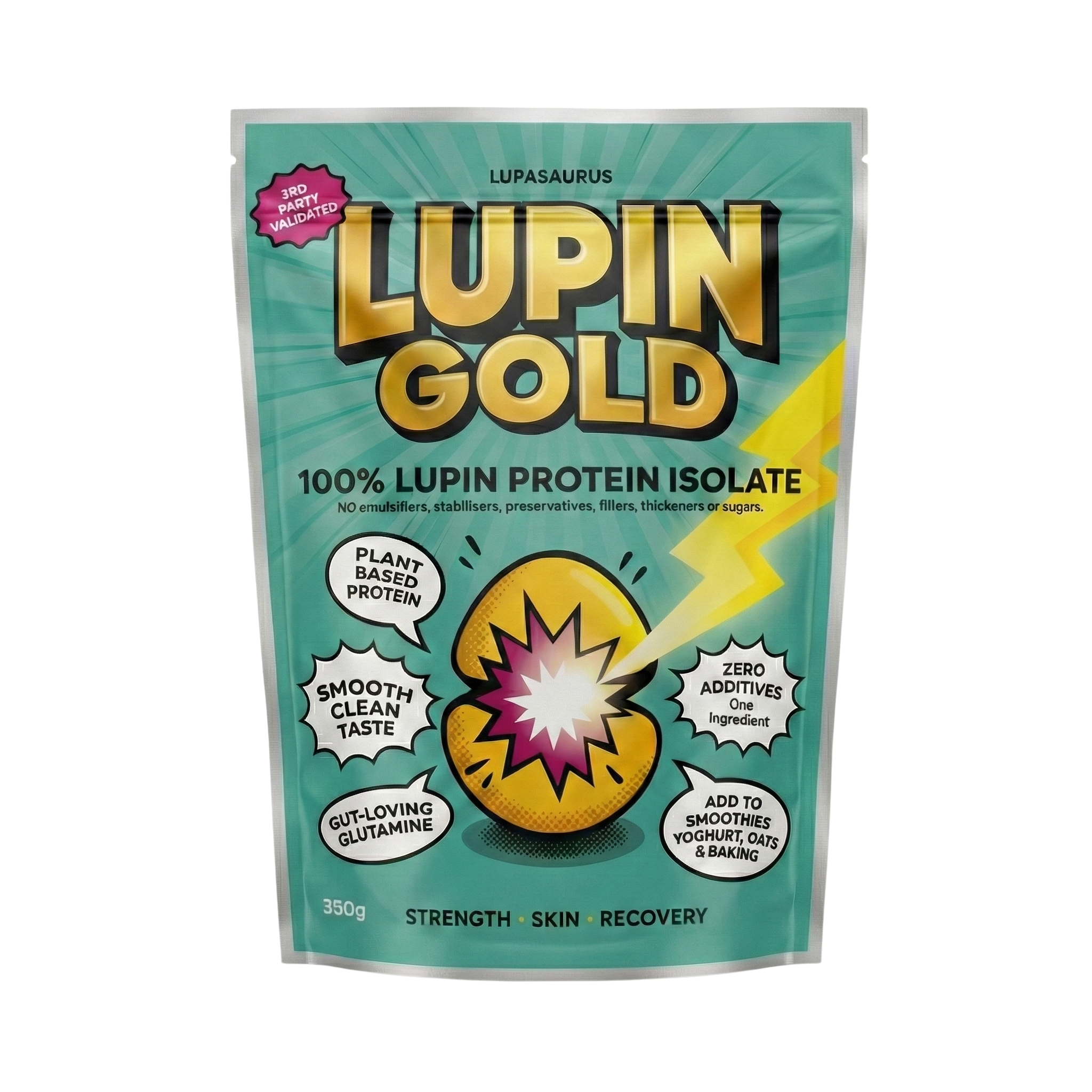
Lupin Gold is both dairy free and lactose free. It is a single-ingredient lupin protein isolate — no whey, no casein, no milk solids, and no lactose, because lupin is a legume and never contained any in the first place. If that is what you are after, see our dairy-free and lactose-free protein powder.
One honest caveat, because it matters: dairy free does not mean allergen free. Lupin is itself a declared allergen in Australia and must be labelled as such, and some people with peanut allergy show cross-reactivity to lupin. If that applies to you, read our allergen information first.
Still working out what is upsetting your stomach?
If the question is what causes the discomfort rather than which label to look for, start with what actually causes bloating from protein powder — lactose is only one of several usual suspects.
FAQs
Is lactose free the same as dairy free?
No. Lactose free means the milk sugar has been removed or was never present. Dairy free means the product contains no milk at all. A lactose-free product can still be full of milk protein, which is why it is not safe for someone with a cow's milk allergy.
Is whey protein isolate lactose free?
Very low, but not necessarily zero. Whey protein isolate typically contains 0.5 to 1.0% lactose, against 4 to 8% for a standard whey concentrate. A serve of isolate carries a fraction of a gram, which most people with lactose intolerance tolerate comfortably, but it is not the same as containing none. Check whether the pack carries an actual lactose-free claim rather than assuming from the word "isolate".
What does "lactose free" legally mean in Australia?
Under Schedule 4 of the Australia New Zealand Food Standards Code, "lactose free" means the food contains no detectable lactose. "Low lactose" means no more than 2g of lactose per 100g. Those are the only two permitted lactose descriptors, and making either claim also requires the nutrition information panel to declare the average quantity of galactose.
Is "dairy free" a regulated claim in Australia?
No. The phrase does not appear in the Food Standards Code. Allergen-free claims like "dairy free" sit under Australian Consumer Law, which prohibits misleading and deceptive conduct, rather than under a defined food standard. There is no set threshold and no required test behind the phrase, so it should be read alongside the ingredient list and the "Contains" statement.
Why does my whey isolate say "Contains milk" if it is low in lactose?
Because the allergen declaration is about protein, not sugar. Milk is a mandatory declared allergen in Australia and the requirement extends to milk derivatives, so whey must declare milk regardless of how little lactose it contains. The two rules answer different questions and can both apply at once.
Can someone with a milk allergy use a lactose-free protein powder?
No. ASCIA states that lactose-free milk and similar products are not suitable for people with cow's milk allergy and may cause anaphylaxis, because removing the sugar does nothing about the milk protein that causes the reaction. Anyone managing a milk allergy should be guided by their doctor or allergy specialist, not by a front-of-pack claim.
How much lactose can a lactose-intolerant person handle?
The European Food Safety Authority's assessment is that the vast majority of people with lactose maldigestion tolerate up to 12g of lactose in a single dose with no or minor symptoms, roughly what is in a cup of milk. But symptoms have been reported in some people below 6g, and there is no single threshold that fits everyone. Tolerance also depends on whether it is taken with food.
Do plant proteins contain lactose?
No. Lactose is synthesised only in the mammary glands of mammals and is found nowhere else in nature, so plant proteins such as lupin, pea, soy and rice contain none. It is not removed during processing; it was never there.
Disclaimer: This article is for general information only and reflects our own research and understanding at the time of writing. We are not scientists or medical professionals, and information may evolve. It is not individual medical advice. If you are managing a food allergy or persistent digestive symptoms, please speak with your doctor or an allergy specialist.