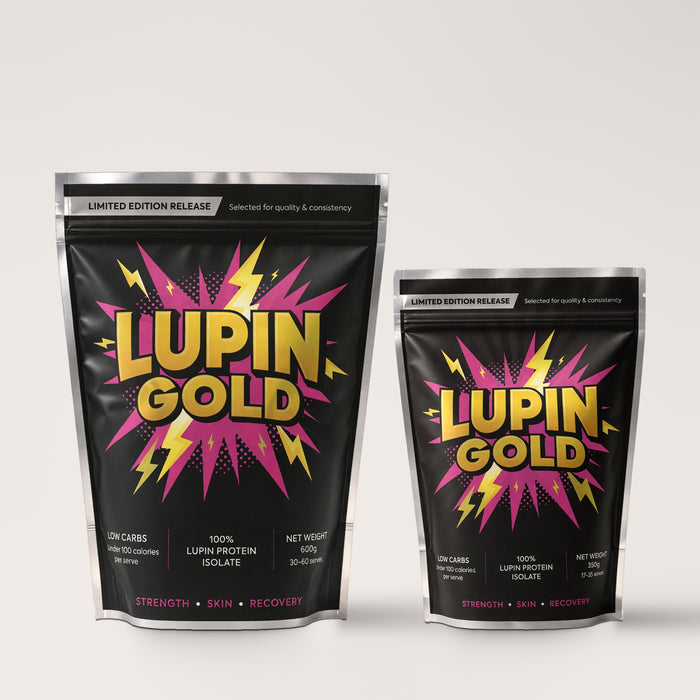

Lupin flour and almond flour both turn up in low carb and wheat-free baking, but they are very different foods. Here they are side by side from the Australian Food Composition Database (AFCD), with our lupin protein isolate's panel next to them and what our own recipes actually do.
Quick answer: Per 100 g, lupin has about twice the protein of almond meal (37.5 g against 19.7 g), about a sixth of the fat (7.9 g against 50.5 g) and a little over half the energy (1,320 kJ against 2,386 kJ). Almond meal is lower in carbohydrate (5.4 g against 10 g). Lupin has well over twice the fibre (27.8 g against 11 g). Figures are AFCD Release 3; the AFCD has no lupin flour entry, so dehulled lupin splits (the kernel that is milled into flour) stand in for it.
Quick navigation
Lupin Flour vs Almond Flour per 100 g
The AFCD lists "almond meal", which is what most Australian recipes mean by almond flour. It has no entry for lupin flour, so the closest is lupin dehulled splits: the lupin kernel with the hull taken off, which is what lupin flour is milled from. Its lupin flakes entry (F005248) is almost the same, at 36.9 g of protein and 27 g of fibre.
| Per 100 g (AFCD) | Lupin, dehulled splits | Almond meal |
|---|---|---|
| Energy | 1,320 kJ | 2,386 kJ |
| Protein | 37.5 g | 19.7 g |
| Fat, total | 7.9 g | 50.5 g |
| Saturated fat | 1.08 g | 3.81 g |
| Carbohydrate | 10 g | 5.4 g |
| Sugars | 2.8 g | 5.2 g |
| Dietary fibre | 27.8 g | 11 g |
| Sodium | 50 mg | 0 mg |
Source: Australian Food Composition Database, Release 3 (Food Standards Australia New Zealand), food keys F005249 (lupin, dehulled, splits, uncooked) and F006077 (almond meal). Carbohydrate is available carbohydrate, which leaves out fibre, as on Australian nutrition panels.
The two foods come at baking from opposite ends. Almond meal is mostly fat: just over half its weight. Lupin is mostly protein and fibre: together, about 65 g of every 100 g.
Per 30 g
Few recipes use 100 g of either, so here is a 30 g amount, worked from the same AFCD figures.
| Per 30 g | Lupin, dehulled splits | Almond meal |
|---|---|---|
| Energy | 396 kJ | 716 kJ |
| Protein | 11.2 g | 5.9 g |
| Fat, total | 2.4 g | 15.1 g |
| Carbohydrate | 3 g | 1.6 g |
| Dietary fibre | 8.3 g | 3.3 g |
For the same 30 g, lupin gives you about 5 g more protein and about 13 g less fat. Almond meal has about 1.4 g less carbohydrate.
Where Our Isolate Fits
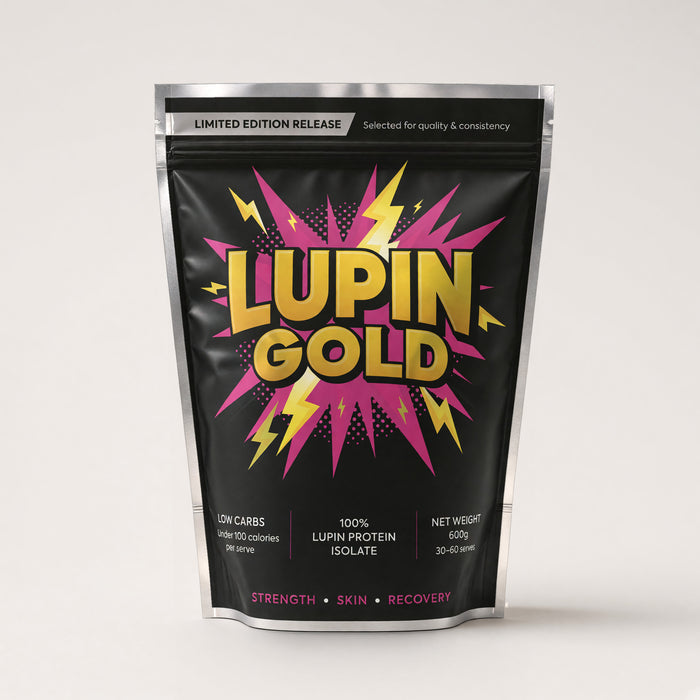
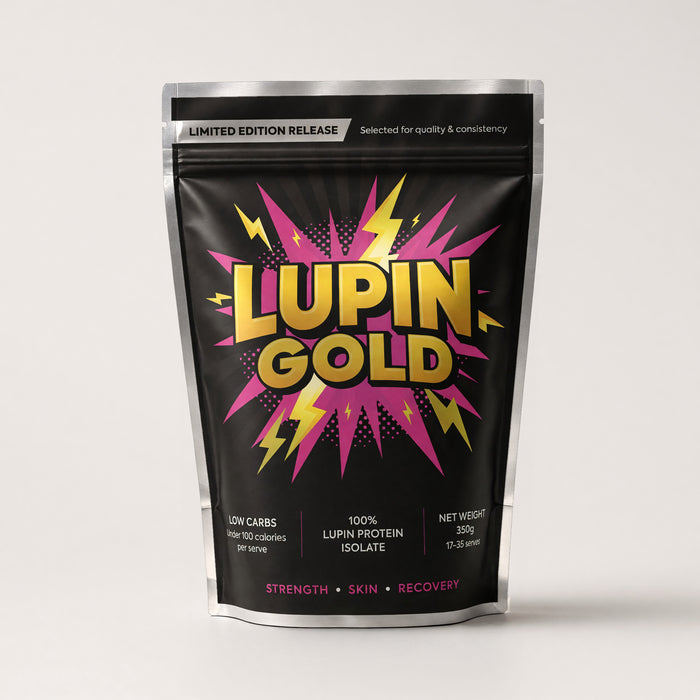
Lupin Gold is not lupin flour. It is lupin protein isolate: the protein separated out of the lupin and dried, so it reads very differently again. Figures are from the nutrition panel on our 600 g lupin protein isolate.
| Per 100 g | Lupin Gold isolate | Lupin, dehulled splits (AFCD) | Almond meal (AFCD) |
|---|---|---|---|
| Energy | 1,744 kJ | 1,320 kJ | 2,386 kJ |
| Protein | 90 g | 37.5 g | 19.7 g |
| Fat, total | 6.7 g | 7.9 g | 50.5 g |
| Carbohydrate | <0.1 g | 10 g | 5.4 g |
| Dietary fibre | <0.5 g* | 27.8 g | 11 g |
| Sodium | 1,400 mg | 50 mg | 0 mg |
*Fibre was not specifically tested; we estimate it at about 3%, so read the fibre figure as a floor. The isolate's sodium is naturally occurring: 280 mg in a 20 g serve.
Refining takes most of the fibre and carbohydrate out with the starch, which is why the isolate is about 90% protein and the flour is not. It is used in smaller amounts than a flour, mixed through the flour you already use, rather than as a flour in its own right.
Baking With Each
Neither is a wheat flour, so neither builds the stretchy structure wheat gives a dough. Beyond that, they behave differently because of what is in them:
- Almond meal is about half fat by weight, with less protein and fibre than lupin.
- Lupin flour is high in protein and fibre and low in fat. Our lupin flour guide covers how much of a wheat flour to swap for it, and why it is usually a partial swap.
- Our isolate is almost all protein and unflavoured, so it goes in with a flour rather than replacing one.
We have not tested lupin flour as a straight swap for almond flour in our own kitchen, so we are not going to give you a ratio for it. With this much difference in fat and fibre, a one-for-one swap will change the texture of a recipe.
What Our Recipes Do
These are our own recipes, and the quantities are copied from each recipe card. None of them uses lupin flour; they show how the isolate goes in next to almond meal, wheat flour and oats.


The pattern across our bread doughs: the isolate is about a tenth of the flour weight, or less, with the rest the usual flour. You can find the isolate with our other gluten-free and dairy-free protein powders. For the carbs in each flour next to wheat and chickpea flour, see is lupin keto?
Allergen note: lupin is a declared allergen in Australia. People with peanut or other legume allergies should review the allergen information page before use.
FAQs
Is lupin flour better than almond flour?
It depends what you want from it. Per 100 g in the AFCD, lupin has more protein (37.5 g against 19.7 g) and fibre (27.8 g against 11 g) and much less fat (7.9 g against 50.5 g). Almond meal has less carbohydrate (5.4 g against 10 g).
Which has more protein, lupin flour or almond flour?
Lupin. The AFCD's closest lupin entry, dehulled splits, has 37.5 g of protein per 100 g, against 19.7 g for almond meal.
Which is lower in carbs, lupin flour or almond flour?
Almond meal, at 5.4 g of available carbohydrate per 100 g against 10 g for dehulled lupin. Both are far below plain white wheat flour at 73.2 g.
Can I use lupin flour instead of almond flour?
We have not tested it as a straight swap, so we do not give a ratio. Almond meal is about half fat and lupin is high in protein and fibre, so a one-for-one swap will change the texture.
Is lupin protein powder the same as lupin flour?
No. Lupin flour is the milled kernel. Our isolate is the protein separated out of it, at about 90% protein with under 0.1 g of carbohydrate per 100 g.
Disclaimer: This article is for general information only. Figures come from our nutrition panel, the manufacturer's specification and the food composition databases named above, and are approximate. It is not individual medical or dietary advice.